Two quotations for “0.50 mm PCB drills” may describe different tools. One may include a particular flute length; the other may leave it unspecified. Pack quantities, tool condition and delivery terms may differ too. Comparing the unit price before resolving those details can hide the real difference between the offers.
A useful request for quotation (RFQ) gives each supplier the same specification and asks them to state any exceptions. Keep one line per required tool combination, with quantities against each line.
Give each tool combination its own line
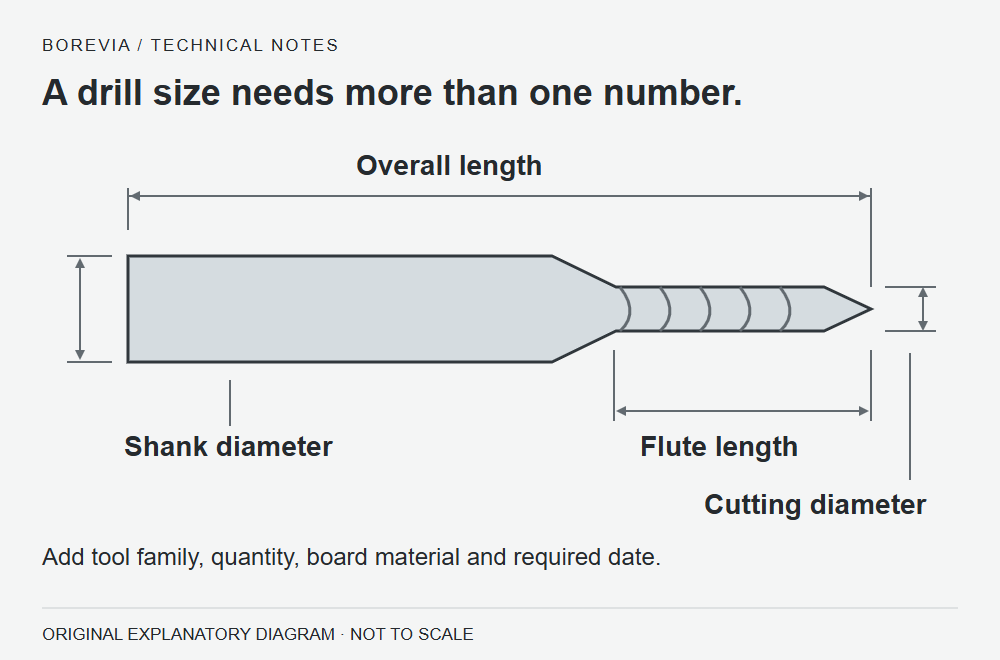
Write the tool family, cutting diameter, flute or working length, shank and overall length. Include the current tool reference or drawing revision if there is one. State whether the request is for new tools or another explicitly agreed condition; do not leave that to assumption.
As a dimensional example, our standard drill catalogue lists a 0.50 mm cutting diameter with an 8.5 mm flute length, a 3.175 mm shank and an overall length of 38.1 ± 0.1 mm. This identifies a catalogue combination. It is not a stock promise, and it does not add a cutting-diameter tolerance that has not been specified.
For undercut drills, include the reduced-body geometry or current reference. For slot drills and router bits, add the feature drawing and intended operation. A routing tool must not inherit the dimensions of a drill merely because both will be used on the same board.
Separate required facts from open questions
If a dimension is not yet known, write “please confirm”. Do the same for a requested coating, tolerance or material grade that is absent from the current reference. This gives the supplier a question to answer instead of an unsupported specification to repeat.
| RFQ section | Include |
|---|---|
| Tool identity | Family, current reference, drawing revision and requested condition. |
| Dimensions | Cutting diameter, flute or working length, shank, overall length and explicitly required tolerances. |
| Application | Board material, thickness or stack, operation and relevant machine details. |
| Quantity | Quantity per specification, sample quantity and any forecast shown separately. |
| Delivery | Destination country or postcode, required date, shipping basis and any requested split shipment. |
| Acceptance | Dimensional checks, trial requirements, batch identification and documents to be agreed. |
Download the blank RFQ checklist (CSV) ↗
Ask for the basis of the price
Ask whether the price is per tool, per pack or per lot, and request the quantity in each pack. Confirm currency, minimum order quantity by specification and any separately charged sample or shipping cost. Forecast quantities should be labelled as forecasts, not mixed into the firm order.
For international delivery, ask the supplier to state the shipping terms and named destination. A tool price without a clear delivery basis is not enough to compare the total purchase cost. Lead time should also state its starting point, such as order confirmation or approval of an outstanding specification.
Agree what the sample must demonstrate
Write down which dimensions and machining results will be checked, by whom, and under what recorded conditions. If comparing suppliers, use comparable board material, equipment and inspection methods. Keep any changed settings in the trial record.
A sample result on one board does not establish universal tool life. Do not turn a supplier’s general description into an acceptance limit without an agreed test. Our drill selection checklist covers the application details to resolve before selecting the sample.
Keep a short list of quotation exceptions
Alongside each offer, record what is confirmed, substituted or still open. Resolve a different flute length, geometry or quantity before issuing the purchase order. Save the accepted specification with the order so the receiving inspection can check the same requirements.
Use our online enquiry form to send the specification lines in the requirements field. The form accepts text, not file uploads; if a drawing is needed, mention it and agree a suitable way to exchange it. Do not send a confidential board design before that arrangement is in place.
Discuss your application
Share the board material, tool dimensions and the issue you are seeing.
Prepare an enquiry ↗